

What Is a Reverse Living Floor Plan?
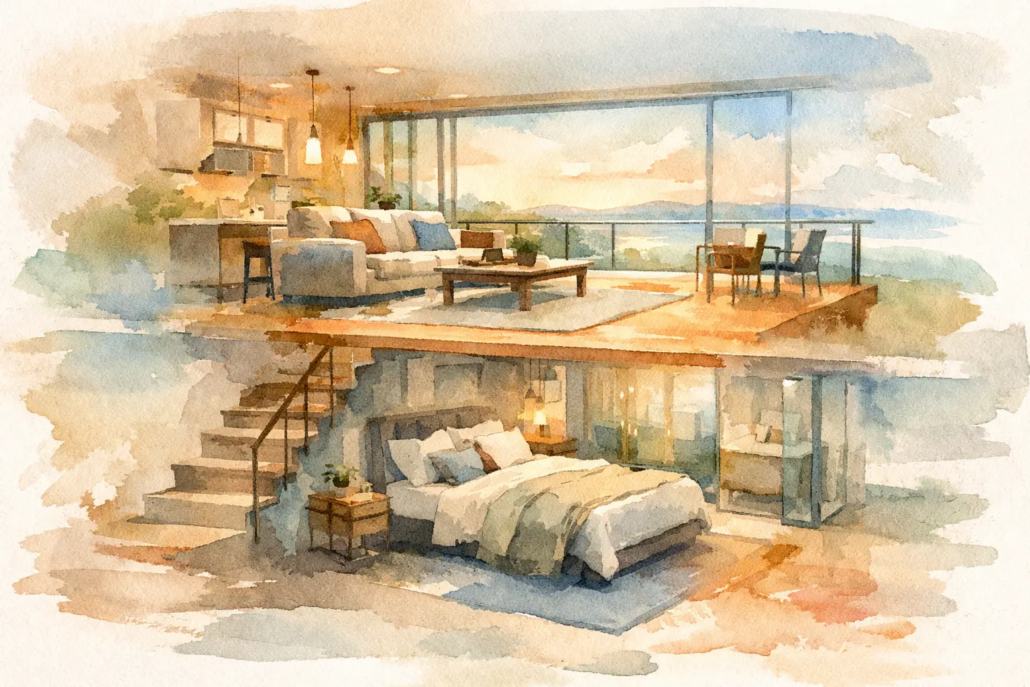
If your block has a view at the back, a slope, or neighbours far too close for comfort, asking what is reverse living floor plan is not just design curiosity – it is a smart first filter. This layout can turn an ordinary house into one that feels sharper, brighter and far better suited to the site. Done well, it is a practical design move. Done badly, it becomes a daily annoyance.
A reverse living floor plan flips the arrangement most Australians grew up with. Instead of placing the main living, kitchen and dining areas on the ground floor and bedrooms upstairs or tucked away at the rear, reverse living puts the primary living zone on the upper level and often places bedrooms below. The idea is simple: lift the spaces you use most during the day to where the light, breezes and outlook are better.
That sounds straightforward, but the real value is in why people choose it. Reverse living is not about being quirky for the sake of it. It is a site-driven response. On a sloping block, a narrow lot, a coastal site, or an infill block with privacy issues, it can outperform a standard layout by a mile.
What is reverse living floor plan design trying to solve?
Most floor plans start with a default formula. Garage at the front, living in the middle or rear, bedrooms grouped away from noise, and maybe an alfresco off the back. That works on plenty of blocks. But when the site has a premium outlook, harsh western exposure, or overlooking from adjoining homes, a stock-standard arrangement can waste the best part of the property.
Reverse living changes the pecking order. It gives the top level to the spaces where people spend the most waking hours. That means the kitchen gets the better view, the dining room captures more natural light, and the family room can open to an elevated balcony or terrace instead of staring into the fence.
For builders, this layout can also make a concept plan more appealing in specific estates or topographies. For buyers, it can be the difference between liking a block and actually making it work.
Why reverse living suits many Australian blocks
In Australia, block conditions vary wildly. You might be dealing with a steep split-level site, a coastal allotment, a narrow inner-suburban lot, or an acreage parcel where the best outlook sits above the tree line. Reverse living has real traction because it responds to these conditions rather than fighting them.
On a sloping site, lifting the living area can align naturally with the landform and reduce awkward internal level changes. On a coastal or elevated block, it lets the main zone capture breezes and views instead of giving that advantage to a spare bedroom. On tighter suburban sites, it can improve privacy by pulling the busiest part of the house away from the street and neighbouring windows.
There is also a lifestyle angle. Many households want an open-plan living area that feels expansive, connected and full of light. Upper-level living can deliver that in a big way, especially when paired with raked ceilings, wide glazing and outdoor spaces that extend off the main zone.
The biggest advantages of a reverse living floor plan
The obvious drawcard is the view, but that is only part of it. A good reverse living design can improve sunlight access, ventilation, privacy and even the overall feel of the home.
Natural light is often better upstairs because there are fewer obstructions from fences, garages and neighbouring walls. That can make the main living zone feel more open and less boxed in. Breezes can also be stronger on the upper level, which matters in warmer parts of Australia where passive comfort is not just nice to have.
Privacy is another major win. If your site faces a busy street or backs onto close neighbours, putting bedrooms downstairs can create a quieter retreat while moving the social hub away from direct sightlines. Elevated living spaces also tend to feel more exclusive and more connected to the landscape.
Then there is the arrival experience. With the right plan, you walk in, move upstairs, and the house opens up properly. It feels deliberate. It feels designed. Not generic.
The trade-offs people forget about
This is where the sales pitch needs a reality check. Reverse living can be brilliant, but it is not the right answer for every household.
Stairs are the first issue. If the kitchen, pantry, living room and main outdoor entertaining area are upstairs, you will be moving up and down more often. Groceries, prams, laundry, young kids, ageing parents – they all change how convenient that feels. Some owners are fine with it. Others hate it within six months.
There can also be cost implications depending on the design. Structural requirements, retaining conditions, elevated outdoor areas and more complex service runs can all affect buildability. That does not automatically make reverse living expensive, but it can move the plan out of the simplest construction bracket.
Thermal performance needs proper thought too. Upper levels can heat up faster in summer if orientation, shading and glazing are handled poorly. A reverse living layout that ignores climate is not clever. It is just upside-down.
When reverse living works best
The strongest reverse living homes are usually driven by one or more clear site benefits. There is a worthwhile view to capture. The block slopes in a way that supports upper-level access or elevated outlook. Privacy is compromised at ground level. Or the surrounding built form makes light hard to secure downstairs.
It also works well for households that entertain often and want the main social zone to feel lifted, open and connected to a deck or balcony. Empty nesters and couples often like it because the home can feel more refined and less centred on bedroom corridors and ground-floor sprawl.
For two-storey homes on compact blocks, reverse living can make the upper level do the heavy lifting, literally and visually. It can turn a constrained site into a house that feels larger than it is.
When a standard floor plan may be better
If your block is flat, your best outdoor area sits naturally at ground level, and your household wants easy movement between kitchen, yard and bedrooms, a conventional plan may simply be more practical. Families with very young children often prefer sleeping zones closer to the main living area. Multi-generational households may also want to reduce stair dependence.
The same goes for buyers thinking long term. If ageing in place matters, or accessibility is a major concern, reverse living needs more planning. That might mean including a lift provision, a ground-floor guest suite, or a layout that can adapt later.
There is no design medal for choosing the more complicated option. The best plan is the one that suits the site and the people living in it.
What to look for in a reverse living concept plan
Not every reverse living design is a good one. Some just swap the rooms around and hope for the best. A stronger concept plan resolves circulation, storage, structure and outdoor connection from the start.
Look closely at how entry works. Does arriving at the home feel clear and efficient, or are you pushed straight into a stairwell with no breathing room? Check whether the upstairs living area has direct access to a usable outdoor space rather than a token balcony that fits two chairs and not much else.
Storage matters more than people expect. If bedrooms are downstairs and living is upstairs, you need practical linen, pantry and general storage in the right places. A powder room near upper living is usually a smart move. Laundry placement also needs thought, especially if the clothesline or drying court is at ground level.
Orientation is non-negotiable. The living zone should be positioned to capture the best light and manage heat load properly. Views are great, but if western glass turns the room into an oven, the layout is not doing its job.
This is exactly where a strong concept library becomes useful. A design should not just look good in elevation. It should solve the block with intent.
Is reverse living only for luxury homes?
Not at all. It often appears in higher-end coastal and architectural homes because those projects usually have premium views worth chasing. But the idea itself is not exclusive. Reverse living can work in modest footprints, duplexes, narrow lots and builder-led projects where site efficiency matters.
What matters is not whether the house is flashy. It is whether the upside-down arrangement creates a genuine improvement in liveability. If it gives you more light, better privacy, a stronger indoor-outdoor connection and a more valuable use of the block, it earns its place.
If it is only there because it sounds fashionable, it is probably the wrong move.
What is reverse living floor plan thinking really about?
At its core, reverse living is about refusing bland, one-size-fits-all planning. It asks a sharper question: where should the best part of the house actually go? On the right block, the answer is upstairs.
That does not mean every home should be flipped. It means the layout should respond to the land, the outlook and the way you live, not a tired formula copied from the next estate display. If a reverse living concept gives your site more light, more privacy and a stronger daily experience, it is worth serious attention. A smart floor plan should work harder than the ordinary one – and you should feel that every day you walk through the door.
See our selection of our home range portfolio at https://pacificdesignerhomes.com.au/ = we are different fresh vibrant on trend stylish as not lost in sea of same same utterly boring bland and leave our opposition stuck in the outdated past.
